Most people in 2026 will know the character King Kong for being the central figure for harmless Hollywood blockbusters such as Kong Skull Island (2017), Godzilla vs. Kong (2021) and Lord of The Rings director Peter Jacskons King Kong (2005). This remake_,_ directed by Peter Jackson, is one of my all-time favourite films. Whilst I acknowledge it certainly isn't objectively a “great” film, “subjectively” I love it.
So, I was very excited to go back and watch the film that spawned it all, but after watching the original King Kong (1933),
I finished the film disappointed, and at times during the film found myself to be quite bored, ironically during the scenes in the film that I'm sure the director Merican C. Cooper intended the audience to be the most invested in.
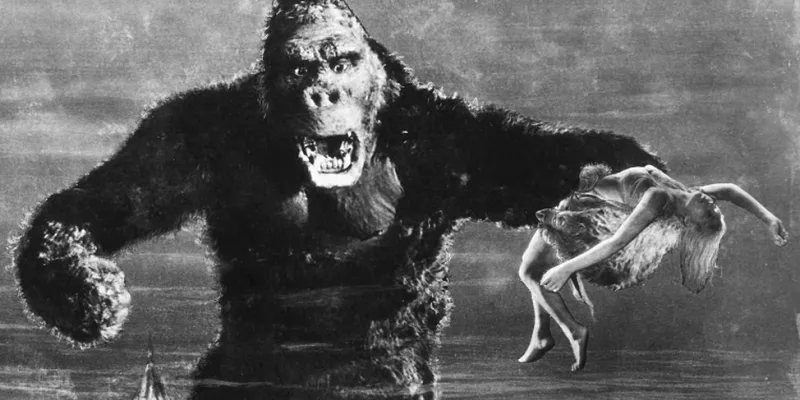
Scenes such as the fights Kong has with the island's other monsters. I put this down to the action sequences being stop motion, (although there is no question of the brilliant craftsmanship and dedication to achieve what they did here), and by today's standards the now poor looking models.
I do not believe this to be the film's fault however. Since 1933 film techniques and knowledge have come an awfully long way. For this reason, it is important to remind ourselves of when this film was made whilst watching it, and of just how huge of a technical feat this film was for the time period. Obviously if we compare the 1933 version to the 2005 remake, and the way Kong looks, the island, and any and all other creatures and monsters on the island, it will seem almost comedic and uninteresting.
The film is told with a linear narrative that begins with a film director named Carl Denham, who is about to venture by ship to an island he has heard, Kong, a “native superstition" resides and intends to shoot a new jungle adventure film out there. Still needing a leading female actress for his film, he goes out into the streets of New York, hoping to find a new star. He comes across a woman called Anne Darrow stealing at an apple from a fruit and vegetable stall, and after paying the owner for her misdeed, whisks her away to get some food and persuade her to be in his new film. She agrees, and Carl, Anne and the rest of the crew set sail.
Modern day problems
It is on the ship that we first encounter the problematic way this film deals with race and racial stereotypes. We meet Charlie, who is Asian and is the chef for ship. He is depicted in a stereotypically racist way,
Colin McMahon wrote in his review “Dressed in Chinese garb, with traditional Chinese facial hair and even a name that started with “Ch” – it’s tough to argue that Charlie was in no way stereotypical.” (McMahon, 2020)
Further problematic stereotypes arise when the crew arrive on the island and have a run in with the indigenous people who live there. They are shown to be overly primitive, and stereotypical in the way Hollywood depicts African tribes. The tribe in this film are an amalgamation of African tribes and identity, and do not have their own unique identity. There has been a lot written about the racism displayed in this film, and if interested to learn more, the book: “Tracking King Kong” written by Cynthia Erb is a great place to start.
After Anne is kidnapped by the tribe in order to sacrifice her to Kong, the crew members led by Carl and Jack go out to search for her. The film then shifts from its themes of romance and drama to action and horror. Almost immediately they come face-to-face with a stegosaurus and have to kill it in order to progress deeper into the jungle. Then a brontosaurus, until finally Kong himself, and after emerging victorious Carl has the (not so) genius idea to bring Kong back to New York as the 8th wonder of the world.
The performances of the actors in the film are quite theatrical; however, this is typical of films released in this time period. One of the biggest complaints I have about the film is towards the character of Anne. Anne, along with Fay Wray who plays her, almost becomes redundant once she is captured and then sacrificed to Kong. Furthermore, she seeks constant approval from men in the film and naively kisses Jack after he confesses his love for her. With the way Anne is written in this film I was surprised to learn it was co-written by a woman, Ruth Rose.
Overall, the film is definitely worthy of a watch if you’re a fan of either Kong, monster films in general, or if you’ve set yourself a goal to watch some old classics. I do not believe a casual movie goer would get much enjoyment out of this. As briefly mentioned earlier, the film has representation issues, the acting and monsters do feel dated, but there are things to be admired about this Hollywood classic.